Why I Built The Quiet Connector
The Quiet Connector exists for introverted women who know what they think — but do not always have access to it in the moment it matters.
You are thoughtful. Capable. Good at what you do.
But when a question lands in a meeting before you are ready, or the room is moving quickly and the pressure is on, that does not always show.
You might go blank.
You might start speaking and lose the thread halfway through.
You might stay quiet too long, miss the moment, and think of the right answer afterwards.
That gap — between what you know and what you manage to say in live work moments — is the problem this business is built to solve.

You do not need to become louder. You need a better way to respond.
For a long time, the advice given to women in these moments has been some version of:
Speak up more.
Think on your feet.
Be more confident.
But that is not a method.
And for a lot of introverted women at work, it does not help.
The problem is often not that you have nothing to say. It is that high-pressure work moments tend to reward fast, polished, immediate answers — and that format does not suit everyone.
If you do your clearest thinking before or after the pressure moment, rather than inside it, that can create a real disadvantage at work. It can look like hesitation. Or vagueness. Or not being on top of things. Even when none of that is true.
This is not a personality flaw.
It is a structural mismatch.
And it needs a practical solution, not more generic confidence advice.

I know this problem personally
I created The Quiet Connector because I know what it feels like to have something useful to say — and not be able to get to it quickly enough when the room is waiting.
I know what it is like to leave a work conversation replaying it in your head.
To think, I knew that. Why could I not say it more clearly at the time?
For years, I assumed the answer was confidence, speed, or somehow becoming better at being the kind of person who can respond instantly under pressure.
It was not.
What changed things for me was not becoming louder, faster, or more naturally “good in the room.”
It was finding a structure that worked with how I actually think.
What changed for me
The shift was simple, but important.
I stopped treating reflection as a weakness.
I stopped assuming that if I could not produce the perfect answer immediately, I had somehow failed.
And I stopped trying to solve the whole problem by becoming faster.
Instead, I started building methods that made real work moments easier to handle.
A way to buy myself a few seconds without sounding evasive.
A way to find the first clear sentence when my mind went blank.
A way to stop rambling once I had started.
A way to prepare before meetings without over-preparing.
And a way to follow up afterwards so my thinking still counted, even when it had not fully landed in the room.
That is what The Quiet Connector is built around: not performance, but structure. Not “just be more confident,” but practical tools that help you respond more clearly, calmly, and credibly when the pressure is on.
What The Quiet Connector stands for
The Quiet Connector is not about teaching introverted women to be more extroverted.
It is not about becoming louder for the sake of it.
It is not about performing confidence.
It is not generic self-help, mindset coaching, or vague encouragement to “put yourself out there.”
It is about helping thoughtful women handle live work moments more clearly.
Everything here is designed to be practical, specific, and rooted in real work situations.
The aim is not to change how you think. The aim is to help the clearest version of you show up when it matters.
- going blank in meetings
- struggling to answer on the spot
- rambling once you begin
- missing the moment to contribute
- thinking of the right answer afterwards
- using follow-up as authority rather than as apology
Most communication advice still assumes the answer is to push harder.
Be quicker.
Speak sooner.
Sound more certain.
Take up more space.
The Quiet Connector takes a different view.
What helps is having the right thing ready before you need it.
A clear method for the moment a question lands.
A simple prep system before a meeting.
A way to recover when you lose the thread.
A follow-up approach that turns later thinking into something useful and credible, rather than something you keep to yourself.
Practical tools reduce pressure.
And when the practical part works, confidence tends to follow. Not the other way around.
What I bring to this work
Over the years, I have spent a long time thinking about why some work situations feel disproportionately difficult for people who think before they speak — and what actually helps.
What I have seen again and again is that the problem is rarely a lack of intelligence, insight, or preparation.
It is usually a lack of access in the moment, combined with a lack of methods that fit the way thoughtful people naturally process.
Give someone a structure that works with their natural style, and things begin to shift.
They contribute earlier.
They speak more clearly.
They recover faster when they lose the thread.
They follow up with more authority.
They stop assuming the answer is to become someone else.
They start working with what is already strong in them.
What you will find here
Inside The Quiet Connector, you will find practical support for the work moments that tend to go wrong under pressure.
This is work-focused, practical support for introverted women who want to be heard more clearly at work — without forcing extroversion.
• resources for the moment your mind goes blank
• tools for preparing before meetings
• methods for structuring your response in the room
• support for stopping the ramble before your point disappears
• templates and frameworks for following up afterwards, when your clearest thinking arrives later
• a fuller toolkit for the wider pattern, not just the one blank moment
Start here
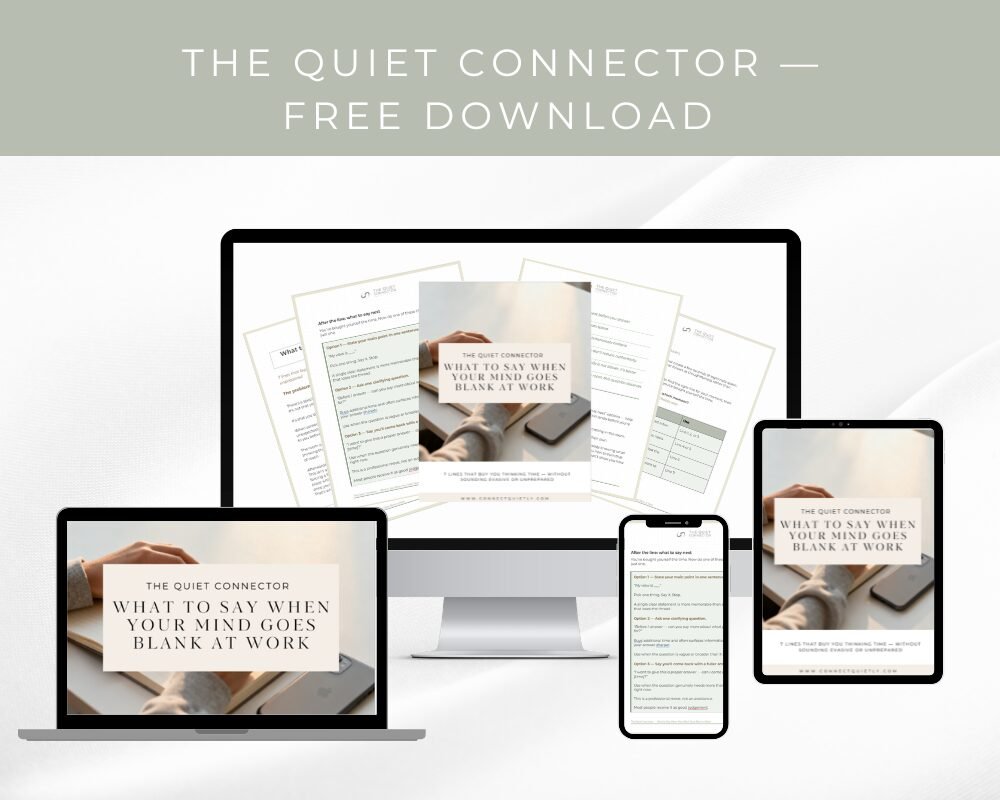
If this problem feels familiar, start with the free guide:
What to Say When Your Mind Goes Blank at Work
It is a practical first step for the moment a question lands before you are ready — with professional lines that buy you time, a quick-pick guide, and what to say next.
And if the blank moment is part of a bigger pattern — if you also ramble, stay quiet too long, struggle to prepare for meetings, or think of the right answer afterwards — the full toolkit is there for that too.