

Know Exactly What to Say at Work — Without Forcing Yourself to Think Faster
For introverted women who go blank in meetings, ramble once they start, or think of the right answer afterwards.
You are not struggling because you have nothing to say. You are struggling because high-stakes work moments reward fast, confident-sounding answers — and that format does not suit everyone. The Quiet Connector gives you practical tools to handle those moments more clearly, calmly, and credibly, using a method that works with how you actually think.
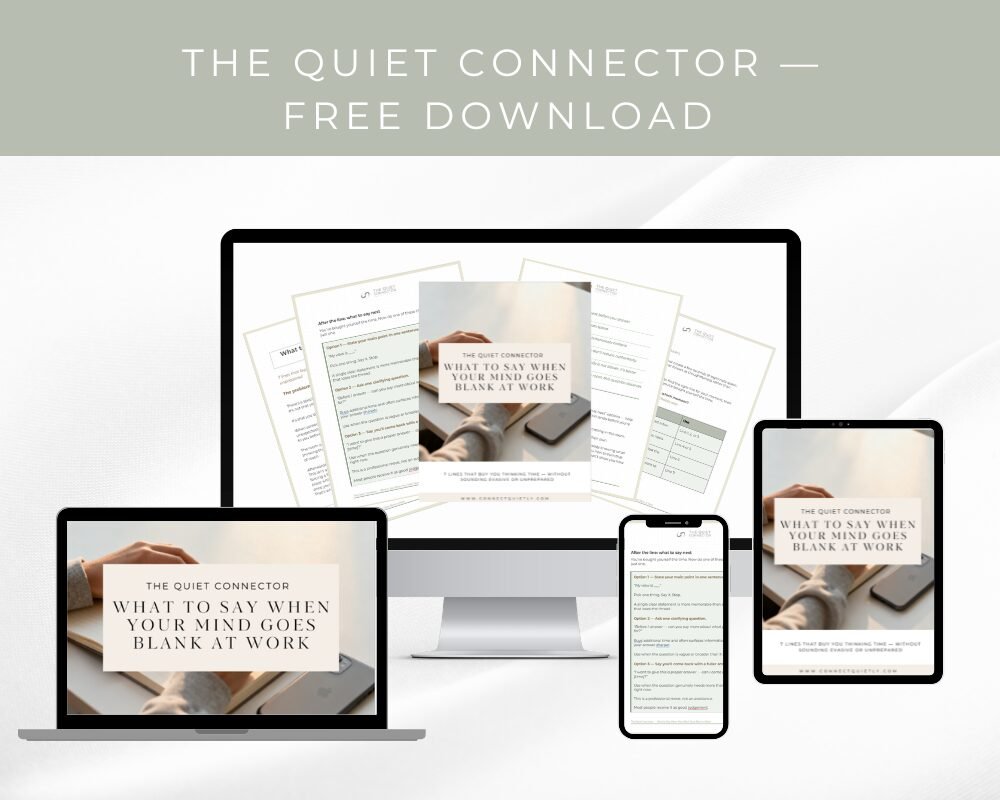
Start with: What to Say When Your Mind Goes Blank at Work
7 lines, a quick-pick guide, and what to say next.
You’re good at what you do. The problem is the moment.
You listen carefully. You prepare properly. You think before you speak.
But when a question lands in a meeting before you are ready — especially when the stakes feel high — the usual advice falls apart.
Speak up more.
Think on your feet.
Sound more confident.
That is not a method. And for a lot of introverted women at work, it does not help.
The Quiet Connector was built to solve a more specific problem: the gap between what you know and what you can access in the room when the pressure is on.
No pressure. No spam. Practical only.
Why this feels hard at work
Workplaces tend to reward the person who answers first, follows up fastest, and sounds certain immediately.
If you do your clearest thinking before or after the pressure moment — not inside it — that creates a real disadvantage.
It can look like hesitation.
Or vagueness.
Or not being on top of things.
Even when none of that is true.
This is not a personality flaw.
It is a structural mismatch.
And it needs a practical solution, not more generic confidence advice.
What You Actually Need (and What The Quiet Connector Provides)
Not more pressure to be louder. Not another confidence pep talk. Not a vague instruction to “just put yourself out there.” What helps is having the right thing ready before you need it.
A clear method for live work moments
So when a question lands, you know how to buy time, structure your response, and land your point.
A simple pre-meeting prep system
So you stop walking into important meetings empty-handed.
A way to stop rambling once you start
So your point does not get buried halfway through your own answer.
A follow-up method that builds authority
So when your clearest thinking comes later, it still counts
Practical tools you can actually use
Quick-reference cards, prep sheets, templates, and short walkthroughs, not more theory.
Everything here comes from lived experience and more than 25 years of helping introverts across the UK, Australia, and North America find a way that actually fits.
Start here — free
What to Say When Your Mind Goes Blank at Work
A practical free guide for the moment a question lands before you are ready.
Inside, you’ll get:
- 7 professional lines that buy you thinking time
- a quick-pick guide so you know which one fits which moment
- a short “what to say next” framework
- a 10-minute setup so it is ready before your next meeting
This is not a confidence exercise.
It is a small, usable response system for one specific workplace moment.
No pressure. No spam. Practical only.
Quiet Clarity — The Blog
What is happening. Why it is happening. What to actually do about it.

Introversion vs Autism: Understanding the Difference Between Personality and Neurotype
There’s a question that comes up surprisingly often, sometimes from introverts themselves, sometimes from people trying to understand the quiet

Why Don’t Introverts Speak Up in Meetings? It’s Not What You Think
You’re in a team meeting. Someone asks for input. The extroverts respond immediately—overlapping, building on each other’s ideas, thinking out

Can Introverts and Extroverts Be Friends? When Different Energy Needs Work
You have a friend who lights up in crowds. They thrive at parties, they know everyone, and they can talk

I created The Quiet Connector because I know this problem well.
I know what it feels like to have something useful to say in a meeting and not be able to get to it quickly enough when the room is waiting.
I also know how easy it is to assume the answer is confidence, when the real issue is often structure.
What changed things for me was not becoming faster, louder, or more naturally “good in the room.” It was finding a way to respond that worked with how I actually think.
That is what this business is built around now:
practical tools for introverted women at work who want to land better in the moments that matter.